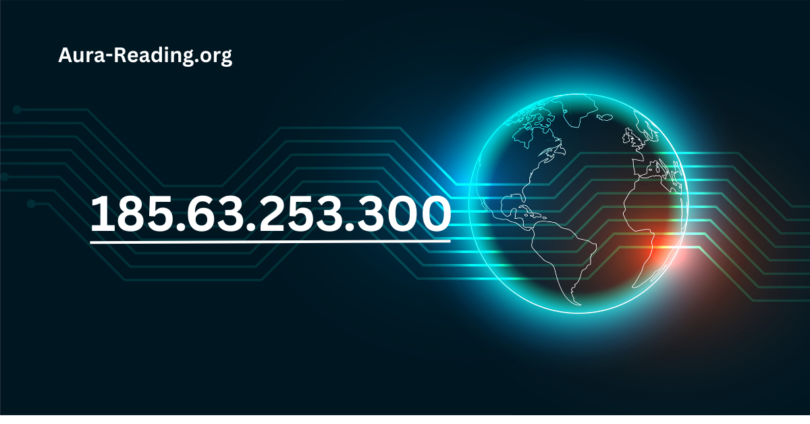

Digital communication relies on IP addresses. With its own distinct identification, every internet-connected gadget may transmit and receive data with ease. However, there is a difference between all IP addresses. Consider the seemingly mundane line of integers 185.63.253.300; it causes techies to raise an eyebrow.
Why? Since it lacks validity! You have come to the correct spot if you are interested in learning the criteria for an IP address’s validity. We’ll take a look at the inner workings of these numerical codes, analyse why 185.63.253.300 doesn’t function, and provide advice for dealing with such problems in the future.
Come explore the intriguing world of IP addresses with us as we learn all about network communication with this specific set!
Understanding the Components of an IP Address
The numerical portion of an IP address is separated by periods. When it comes to recognising devices on the web, every component is vital.
The first part shows the overall network architecture, while the rest of it helps to identify individual nodes. Using this hierarchical structure, communication across huge networks is kept organised.
There are two types of IP addresses: IPv4 and IPv6. A restricted number of possible permutations result from the former’s use of four sets of integers from 0 to 255. But with eight sets of hexadecimal digits, IPv6 greatly increases this range.
In order for routers and servers to transport data efficiently, each component has a specific function. If you want to be a good network manager or navigate online places, you need to understand these components.
The Purpose of IP Addresses and How They Work
Devices linked to a network must have IP addresses in order to be identified. They function similarly to street addresses or phone numbers in that they are distinct identifiers.
Data packets are sent and received by your device while you surf the web. You can identify exactly where data packets are going and how to get them back from them by looking at their IP addresses.
A pair of major versions exist: IPv4 and IPv6. Eight groups separated by colons make up IPv6, in contrast to IPv4’s four sets of numbers separated by periods. With this differentiation, we can better support the ever-increasing variety of connected devices.
Internet Protocol addresses do double duty as identifiers and as tools for efficient traffic routing across networks. For devices all around the globe to be able to communicate with one another, routers examine these addresses and then route data through different web paths.
You May Like: Miuzo Explained: Meaning, Uses & Future Trends
What is 185.63.253.300?
While 185.63.253.300 seems like any other IP address to the untrained eye, it has techies scratching their heads.
The standard format for an IP address is four groups of digits separated by periods. A valid range for each number is 0 to 255. The Internet Protocol Version 4 (IPv4) standard has been in use for many years.
One aspect of 185.63.253.300 jumps out, though: the last segment, 300, is greater than the maximum number for an octet.
Because of this inconsistency, it is rather evident that 185.63.253.300 is not an IP address that can be used in either IPv4 or IPv6 network.
Invalid addresses can make troubleshooting networking problems or establishing online communications between devices more complicated and possibly cause connectivity issues.
Why 185.63.253.300 Is Not a Valid IP Address
Because its numerical range exceeds the allowable limits for IPv4 addresses, the IP address 185.63.253.300 is invalid.
Octets, which can take on values between 0 and 255, make up IPv4 addresses. With a final segment of “300,” it’s obvious that this amount is higher than the limit.
Due to this inconsistency, no devices on the network can use this address to properly understand or route data. Since it doesn’t follow normal addressing conventions, basically, 185.63.253.300 will always fail.
Anyone dealing with networking technology must be familiar with these constraints, since the use of an IP address can be rendered useless and connection between devices or networks disrupted by as little as one wrong digit.
Technical Explanation of 185.63.253.300
Octets, which can take on values between 0 and 255, make up an IP address. All IPv4 addresses must fall within this range in order to be valid.
In the case of 185.63.253.300, the last octet goes over this restriction and reaches 300. The format for normal IP addresses does not allow for such a large number.
Devices on any network cannot recognise or route an IP address with such a spelling and grammar error. According to the most fundamental requirements of the Internet Protocol, it does not work.
Possible causes of this mistake include careless typing or a lack of awareness regarding the format of addresses. Accurately formed addresses guarantee reliable connectivity and efficient cross-network communication.
Acquiring this foundational knowledge sheds light on the significance of accuracy when working with networking technologies and explains why specific sequences fail.
Troubleshooting Tips for Dealing with Invalid IP Addresses
Despite the frustration, a methodical approach might help you swiftly fix issues involving invalid IP addresses.
To begin, go into the network settings of your device. For DHCP to work, you must enable automated IP configuration. When dealing with static IPs, this usually fixes the problem.
When that fails, try power cycling your network adapter. If the invalid address problem persists after a reboot, try rebooting the device to eliminate any temporary issues and restore connections.
If the issue continues, you can release and renew your IP address from the command prompt. Press “ipconfig /release” on Windows, then “ipconfig /renew.” Your network will be prompted to assign a new valid address when you do this.
Get the most recent software fixes and firmware updates for your devices. Older systems may have trouble connecting since they aren’t compatible with the networking protocols used today.
Conclusion
Accuracy is key when it comes to comprehending IP addresses. An illustration of this is the fact that not all string of digits can be used as an IP address (185.63.253.300).
Octets, which can take on values between 0 and 255, make up an IP address. For the particular situation of 185.63.253.300, it is clear that the last segment is too long and so invalid.
Network configurations and troubleshooting can become muddled when dealing with invalid IP addresses. Users can better handle these challenges if they are aware of what makes an address genuine.
Be sure to double-check your input ranges and setups before assuming a more serious network issue when you come across an invalid IP address, such as 185.63.253.300.
In today’s hyper-connected world, being able to explain how IP addresses work is crucial for both technical competence and effective digital communication.